The Catch-22 of Phosphate Soil Fertility

by Taylor Strehl, Technical Agronomist
Phosphorus (P) has long been recognized as one of the most critical nutrients in row crop production. It drives energy transfer, root development, and early plant vigor. All are essential for maximizing yield potential [1][2]. As a result, for decades, the dominant agronomic philosophy has been simple: build soil test P to adequate or high levels and maintain it there to protect yield.
There’s a seldom discussed side of this strategy—one that many farmers and agronomists are noticing, especially in tighter margin years. As soil P levels increase, crops often take up more phosphorus than they need to produce maximum yield [3][4]. This leads to a quiet but costly inefficiency :more fertilizer applied, more nutrient removed, and less economic return per pound.
The Traditional Approach: Build and Maintain Phosphorus
Current phosphorus management programs are built using university recommendations.
The “build-and-maintain” approach aims to elevate soil test P levels to a range where crop response to fertilizer is unlikely, then maintain that level over time [5][6].
The benefits are real and well documented:
- Reduced risk of phosphorus deficiency
- Improved early-season growth and root development
- More consistent yield performance across varying conditions
From a risk management standpoint, this approach makes sense. In many cases, it has helped unlock higher yield potential and stabilize production.
However, these recommendations are based on a yield response correlation curve, not by how efficiently crops use phosphorus once it’s available [5].
And that’s where the inefficiencies begin.
Understanding Luxury Phosphorus Uptake
Plants are designed to maximize growth and reproduction—not nutrient efficiency. When phosphorus is readily available in the soil, they will continue taking it up even after their yield requirements are met. This phenomenon is known as luxury consumption [3][4].
In practical terms the plant absorbs more P than it needs to produce yield. That extra phosphorus is stored in plant tissues and is ultimately removed from the field in grain or biomass [7]. Critically, this additional uptake does not increase yield [3].
Instead, it increases the amount of phosphorus removed per bushel, creating a hidden cost in your nutrient program [7]. Luxury uptake becomes more common as soil test phosphorus levels rise, especially in fields testing well above critical thresholds [5][6].
The Feedback Loop: Why More P Becomes Self-Reinforcing
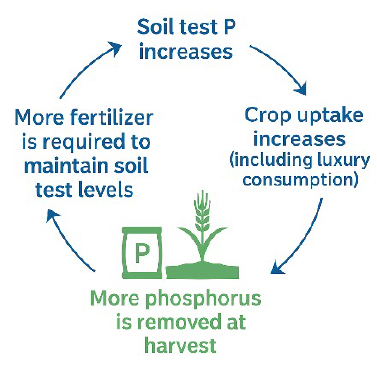
Unlike some nutrients, plants have limited ability to regulate phosphorus uptake once it is abundant [2]. They don’t “shut off” absorption when sufficiency is reached. This creates a feedback loop.
The result? A system that demands higher inputs just to maintain the status quo, with diminishing economic returns [7].
The Economic Impact: Declining Return on Investment
From a financial standpoint, this is where the Catch-22 becomes most evident.
As luxury consumption increases, the phosphorus removed per bushel rises [7]. Replacement fertilizer needs increase, driving cost per unit of production up. Yet yield remains unchanged [6].
In other words, you're spending more on phosphorus without generating additional revenue. This leads to a decline in unit economic efficiency, the return you get per pound of P₂O₅ applied [8]. Because this effect doesn’t show up in yield maps, it often goes unnoticed. But over time, especially with elevated fertilizer prices, it can significantly erode profitability.
Why This Matters More Today Than Ever
- Higher Yield Levels: As yields increase, total nutrient removal increases alongside them [7]. Even small inefficiences become costly at scale.
- Fertilizer Price Volatility: Rising and fluctuating fertilizer costs magnify every pound of inefficient phosphorus use.
- Environmental Pressure: Excess phosphorus removal doesn't just impact economics, it also affects nutrient balances and potential loss risks [9]. Regulatory and sustainability pressures are increasingly focused on phosphorus management.
- Tighter Margins: With less room for error, growers and agronomists are scrutinizing every input more closely. Efficiency is no longer optional; it's essential!
Rethinking Phosphorus Management Goals
The risk of luxury P consumption doesn’t mean high soil test phosphorus is inherently bad. It means we need to rethink what “optimal” management looks like. Instead of focusing solely on building and maintaining soil levels, consider shifting toward efficiency-driven goals:
Optimize, Don’t Maximize: Aim for sufficient not excessive soil P levels. Support yield without promoting unnecessary uptake.
Improve Uptake Efficiency: Focus on getting more crop response from each pound applied, rather than increasing total availability.
Manage Root-Zone Dynamics: Where phosphorus is placed can matter as much as how much is applied. Banding, in-furrow strategies, and localized placement can improve early-season access without oversupplying the entire soil profile.
Explore Advanced Tools: Technologies and approaches that improve phosphorus efficiency are gaining traction, including enhanced efficiency fertilizers like RhizoSorb 8-39-0.
Breaking From the Luxury Consumption Trap
The key takeaway is not to eliminate phosphorus applications or abandon sound agronomic principles. Instead, it’s about recognizing the trade-offs that come with excess fertility.
High soil P levels may reduce the risk of deficiency, but they can also reduce efficiency and profitability if left unmanaged.
Breaking the cycle requires balance:
- Protect yield potential
- Control unnecessary nutrient removal
- Maximize return on every fertilizer dollar
As the industry evolves, the most successful operations will be those that move beyond “more is better” and toward efficient practices.
The future of phosphorus management isn’t just about how much P you apply. It’s about how effectively your crop uses it. By focusing on efficiency, not just availability, you can protect both your yields and your bottom line.
----
About the Author
Taylor Strehl, Technical Agronomist
Taylor is an experienced research agronomist with over a decade of experience in research and development focused on crop nutrition and sustainable agriculture. He previously served as Director of R&D for a sustainability-focused horticultural company, where he led initiatives to advance sustainable growing practices and improve crop performance through innovative, science-driven solutions. For the past 4 years, he has served as the agronomic SME as Technical Agronomist for Phospholutions Inc. He holds a B.S. in Crop Science from the University of Illinois and an M.S. in Biology from Eastern Illinois University, where his research focused on agroecology.
----
References
1. Khan, F., Siddique, A.B., Shabala, S., Zhou, M., & Zhao, C. (2023). Phosphorus plays key roles in regulating plants’ physiological responses to abiotic stresses. Plants, 12(15), 2861. https://doi.org/10.3390/plants12152861 [mdpi.com]
2. Wang, Y., Wang, F., Lu, H., Liu, Y., & Mao, C. (2021). Phosphate uptake and transport in plants: An elaborate regulatory system. Plant and Cell Physiology, 62(4), 564–572. https://doi.org/10.1093/pcp/pcab011
3.Penn, C. J., Camberato, J. J., & Wiethorn, M. A. (2023). How much phosphorus uptake is required for achieving maximum maize grain yield? Part 1: Luxury consumption and implications for yield. Agronomy, 13(1), 95. https://doi.org/10.3390/agronomy13010095
4.U.S. Department of Agriculture, Agricultural Research Service. (2023, April25). Keeping corn from frequenting the phosphorus buffet line. https://www.ars.usda.gov/news-events/news/research-news/2023/keeping-corn-from-frequenting-the-phosphorus-buffet-line/
5. Illinois Extension.(n.d.). Soil phosphorus. University of Illinois Urbana-Champaign. https://extension.illinois.edu/crops/soil-phosphorus
6. Missouri Extension.(n.d.). Phosphorus nutrient management. University of Missouri. https://extension.missouri.edu/programs/nutrient-management/phosphorus
7. Iowa State University Extension. (n.d.). Phosphorus management (PM 1688). https://www.agronext.iastate.edu/soilfertility/4r/ppt/Chapter-3%20Phosphorus%20Management_Ver7.pdf
8. Ros, M. B. H., Koopmans,G. F., van Groenigen, K. J., Abalos, D., Oenema, O., Vos, H. M. J., & vanGroenigen, J. W. (2020). Towards optimal use of phosphorus fertiliser. Scientific Reports, 10, 17804. https://doi.org/10.1038/s41598-020-74736-z
9. Natural ResourcesConservation Service. (2022). Soil phosphorus. U.S. Department of Agriculture. https://www.nrcs.usda.gov/sites/default/files/2022-10/Soil%20Phosphorus.pdf

Insights from Phospholutions

Understanding P Build-Up at the Surface and Depletion Below
Why do some crops struggle to access phosphorus even when soil-test levels appear adequate? Technical Agronomist Taylor Strehl shares how phosphorus stratification develops in modern reduced-tillage and no-till systems, creating uneven nutrient distribution throughout the soil profile. Learn why phosphorus placement, fixation, and accessibility impact crop nutrition, how standard soil tests can miss subsurface depletion, and how RhizoSorb® technology helps improve phosphorus availability by expanding the zone of plant-accessible phosphorus.

The RhizoSorb Efficiency Cascade
RhizoSorb® 8-39-0 helps growers improve phosphorus efficiency while also reducing fertilizer application rates — creating operational advantages beyond nutrient performance. The article explores how lower fertilizer rates can reduce refill stops, improve planting efficiency, streamline logistics, and help growers maximize narrow planting windows. By extending acres covered per fill and reducing downtime, RhizoSorb can improve overall system efficiency and help protect yield potential through more timely planting.

Phospholutions Calls for Fertilizer Efficiency to Be Included in U.S. Supply and Affordability Strategy
As fertilizer affordability and domestic supply concerns continue to intensify, Phospholutions urged policymakers to consider phosphorus efficiency as a practical and immediate lever to strengthen U.S. fertilizer resilience.

Phospholutions Marks Year of Growth; Adoption Accelerates Ahead of Spring Farming Season
Phospholutions today announces a year of commercial growth as the company enters its next phase of adoption. The milestones come as phosphorus has been designated a U.S. critical mineral, with supply increasingly constrained and price volatility rising, highlighting the significant need for greater nutrient efficiency.

Phospholutions Appoints Julia Andrus as Marketing & Communications Manager
Phospholutions announced today the addition of Julia Andrus as Marketing & Communications Manager, strengthening the company’s commercial capabilities as adoption of its phosphorus efficiency technology continues to grow.